WACCI and Partners Close Out Erasmus+ ImPreSSion Project on Transforming Higher Education in Ghana
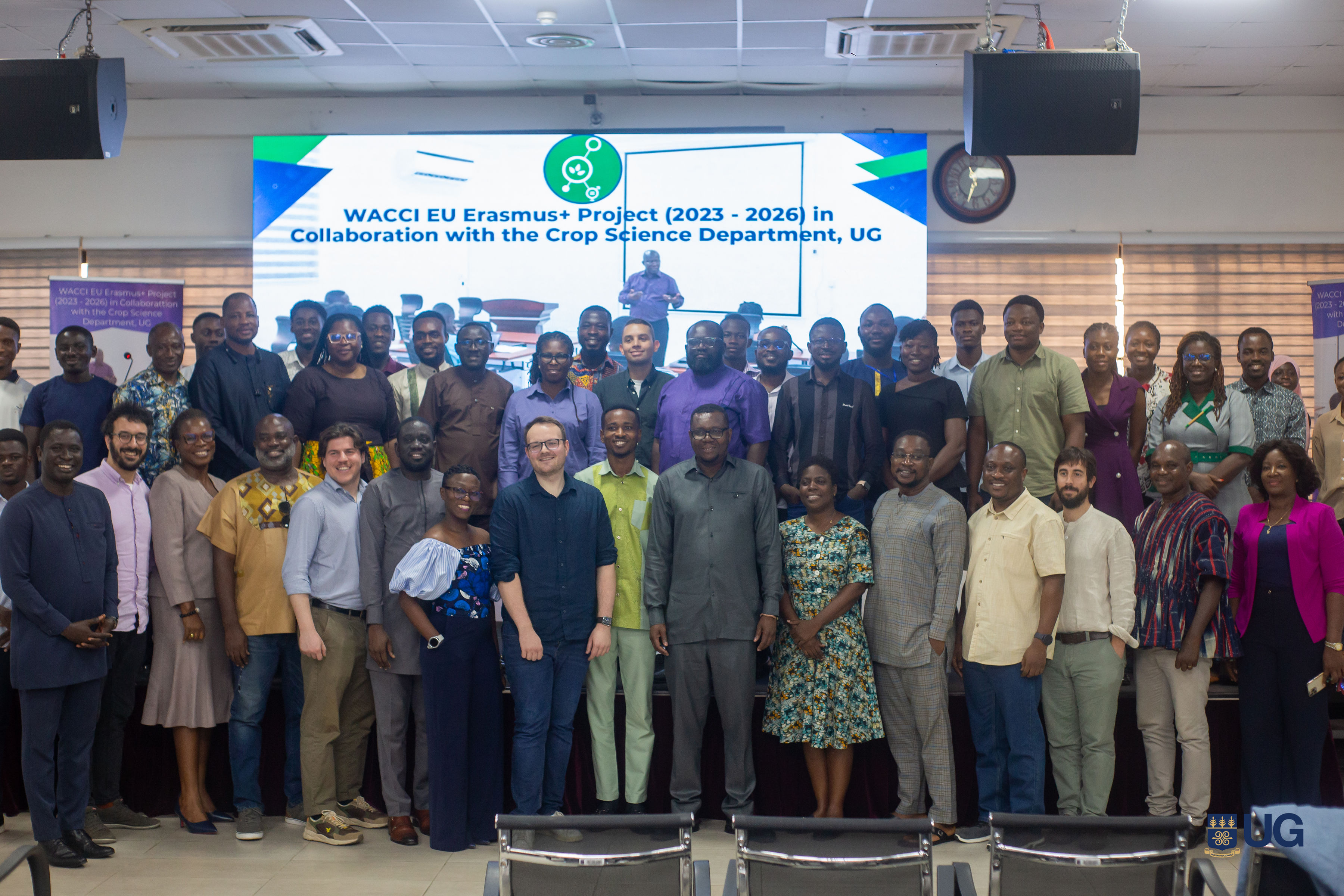
The West Africa Centre for Crop Improvement (WACCI) at the University of Ghana, in collaboration with European and Ghanaian partner institutions, has successfully hosted the close-out workshop for the Erasmus+ ImPreSSion Project.
Held at WACCI, under the theme “Unleashing the Power of Technology for Teaching and Learning,” the workshop brought together representatives from partner universities, industry stakeholders and academic staff to reflect on the achievements of the three-year project and discuss strategies for sustaining its impact.
The Erasmus+ ImPreSSion Project, formally titled “Improving Study Programs in Ghana by Introducing Green Solutions, Sustainability Modules and Digital Transformation,” was implemented by WACCI in partnership with the University of Energy and Natural Resources (UENR), the University of Environment and Sustainable Development (UESD) and European collaborators Politecnico di Milano (POLIMI), Italy and RWTH Aachen University, Germany.
The initiative sought to strengthen the agriculture, water and energy sectors while addressing social, economic and environmental inequalities intensified by the COVID-19 pandemic.
In a welcome address delivered on behalf of Prof. Eric Yirenkyi Danquah, Founding Director of WACCI and Principal Investigator of the project, Prof. Daniel K. Dzidzienyo, Acting Director of the Centre, highlighted the significance of the collaboration.
“The ImPreSSion Project has exemplified the strength of inter-university collaboration between Africa and Europe, focusing on curriculum modernisation, digital innovation, faculty capacity building and stronger alignment between academia and industry,” he said.
“For WACCI and the University of Ghana, this partnership has yielded tangible outcomes, including enhanced digital teaching and learning infrastructure, curriculum improvements informed by industry engagement and strengthened attention to gender equality and social inclusion.”
Prof. Dzidzienyo further explained that the workshop offered an important opportunity to reflect on lessons learned and to explore ways to sustain the achievements of the project.
Dr. Naalamle Amissah, Head of the Department of Crop Science and Associate Director for Gender, Inclusivity and Diversity at WACCI, provided an overview of the project, describing its strategic objectives which she said was among other things to identifying graduate skills needed in agriculture, energy and water programs; modernising study programmes; promoting gender equality and diversity; strengthening faculty capacity; and integrating digital teaching and learning tools.
The project, led by WACCI, oversaw critical work packages, including stakeholder consultations to assess skill requirements and dissemination activities that enhanced visibility through public events, websites and social media. Over the course of the project, participating universities modernised curricula to integrate green solutions, sustainability modules and digital pedagogical approaches.
Faculty members received training through international programs, while advanced e-learning platforms were introduced to facilitate access to massive open online course (MOOCs) and open educational resources. Gender contact persons were appointed and trained, ensuring mechanisms were in place to advance equality and inclusivity.
During the workshop, Mr. Enrico Tagliaferri of POLIMI presented findings from the assessments of the project, noting that prior to the intervention, study programmes were often overly theoretical with limited practical and laboratory-based learning. According to him, students and employers highlighted skills mismatches, particularly in applied and digital competencies, while both faculty and students were relatively unfamiliar with innovative teaching methods such as MOOCs and blended learning.
“Infrastructure gaps, including limited access to laboratories, computing facilities, libraries and reliable internet connectivity, were also identified. ImPreSSion has addressed these gaps by strengthening practical, analytical and digital skills, fostering student-centred learning, and encouraging a culture of reflection and continuous improvement,” Mr.Tagliaferri said.
The workshop also showcased future strategies to scale and sustain the impact of the project. Plans include extending successful practices to additional programmes and faculties, strengthening engagement with national authorities and accreditation bodies, enhancing regional collaboration within West Africa, embedding continuous quality assurance processes and expanding experiential learning and digital education offerings.
Contributions from European partners were highlighted during the interactive sessions. Florian Balmes and Daniel Murillo of RWTH Aachen University shared best practices for integrating digital tools into teaching and learning, while participants from Ghanaian partner universities reflected on lessons learned and experiences over the three-year project. A tour of WACCI facilities, led by Mrs. Barbara Dodoo-Arhin, Assistant Registrar and Centre Administrator at WACCI, allowed attendees to view the infrastructural improvements supported by the project.
The Erasmus+ ImPreSSion Project has contributed to higher education in Ghana by modernising curricula, strengthening faculty capacity, expanding digital learning and engendering regional collaboration.
The project coordinating team during the workshop emphasised that the project has equipped students with the skills needed to meet the demands of a rapidly changing workforce, ensuring that Ghanaian universities remain competitive and responsive in the global knowledge economy.
The event also saw the participation of faculty and project team members from collaborating institutions.