WACCI DSRA Symposium Highlights Opportunity Crops, Innovation and Partnerships for Equitable Development
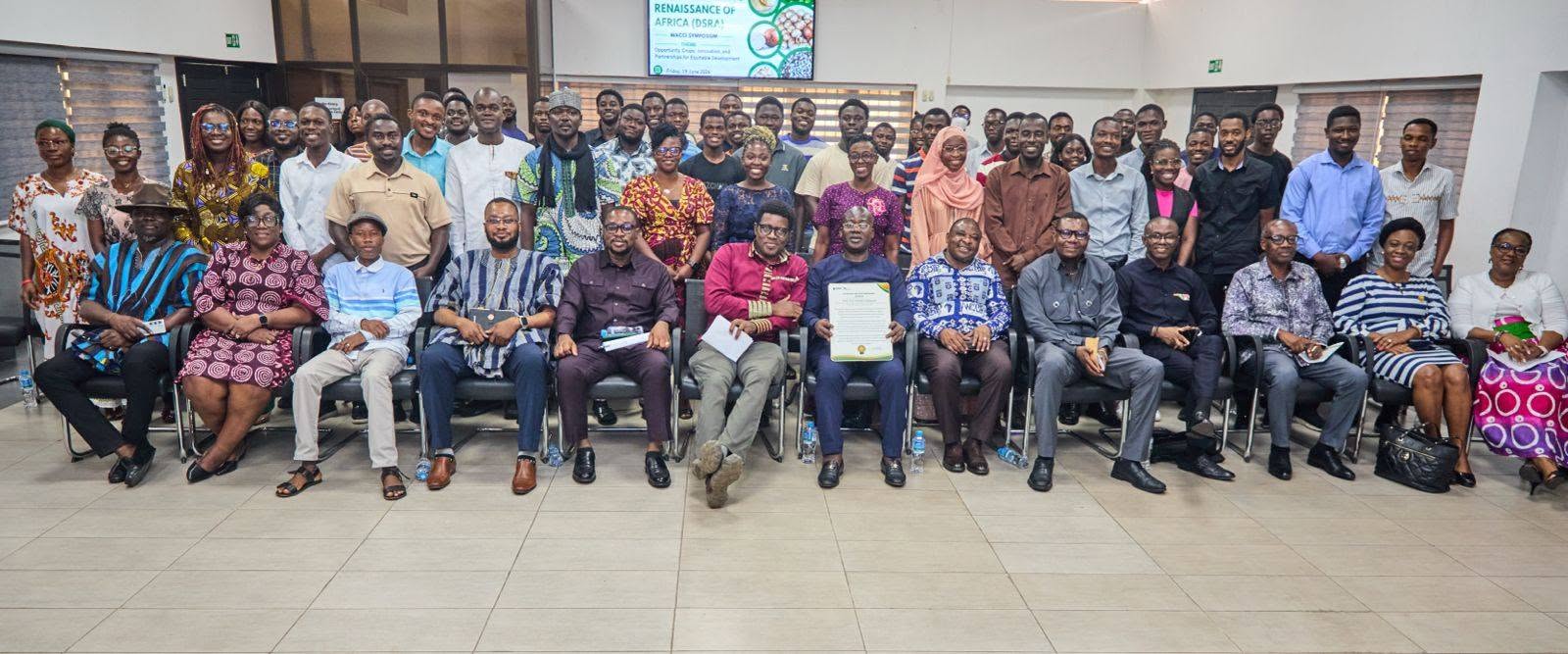
In a bid to strengthen contributions to equitable development through agricultural research, innovation and strategic partnerships, the West Africa Centre for Crop Improvement (WACCI) has organised a symposium to advance dialogue on agricultural transformation and sustainable development.
The event, which forms part of the ongoing University of Ghana celebration of the Day of Scientific Renaissance of Africa, brought together researchers from the Centre and the College of Basic and Applied Sciences, industry players and development partners to explore how science, innovation and collaboration can help address Africa’s food and nutrition security challenges while promoting sustainable development across the continent.
Held at the WACCI Auditorium under the theme “Equitable Development: Research, Collaborate, Empower,” with a sub-theme on “Opportunity Crops, Innovation and Partnerships for Equitable Development,” the symposium focused on strengthening plant breeding capacity, scaling opportunity crops and deepening cross-sector partnerships within Africa’s agricultural innovation ecosystem.
In his framing remarks, the Director of WACCI, Prof. Daniel K. Dzidzienyo, situated the symposium within the broader African Union vision for scientific advancement, noting that the Day of Scientific Renaissance of Africa offers an important platform to reflect on the role of science, technology and innovation in Africa’s development agenda. He explained that WACCI’s contribution through the symposium was to bring an agricultural lens to the continental conversation, particularly on how opportunity crops, improved seed systems and strategic partnerships can address pressing challenges of food and nutrition security.
Prof. Dzidzienyo further observed that opportunity crops should not be seen as emerging or future crops, but as viable and underutilised crops whose potential can be immediately unlocked through targeted investment in research, innovation and value chain development. According to the WACCI Director, achieving equitable development will require stronger collaboration between researchers, industry actors, policymakers and development partners to ensure that scientific outputs translate into real-world impact for farmers and communities.
Provost of the College of Basic and Applied Sciences, Prof. Sandow M. Yidana, who served as Chair for the occasion, underscored the relevance of the DSRA celebrations and how it reinforces the role of science, technology and innovation in advancing Africa’s development agenda.
He commended WACCI for its leadership in agricultural research and capacity development and stressed the importance of collaboration in addressing the impacts of climate change on food systems. The Provost also urged stakeholders to deepen partnerships that strengthen agricultural innovation and resilience.
Delivering the keynote address, Founding Director of WACCI and Chair of the Ghana National Research Fund Governing Board, Prof. Eric Y. Danquah, examined the link between plant breeding capacity, agricultural productivity and national development.
He pointed out that Ghana’s population has grown from about six million at independence to more than thirty-five million today and is projected to reach nearly fifty million by 2050, a trend he said requires a fundamental transformation of national food systems. According to him, while agriculture continues to play a central role in the economy, significant yield gaps across major staple crops still present both a challenge and an opportunity for increased production, improved nutrition and job creation.
Prof. Danquah explained that “opportunity crops” such as soybean, groundnut, cowpea, rice, cassava, yam, millet, sorghum, tomato, Bambara groundnut and orange-fleshed sweet potato have strong potential to contribute to Ghana’s development if supported by sustained investment in plant breeding, seed systems, human capital, value chains and agricultural research financing.
Drawing on WACCI’s nearly two decades experience, he highlighted how sustained investment in scientific capacity has contributed to the training of plant breeders across Africa, the release of improved crop varieties, and the strengthening of agricultural research leadership on the continent. He further observed that with continued strategic investment in Centres of Excellence, African scientists can compete at the highest levels of global science and making breakthrough contributions to innovation.
A key message in his address was that agricultural research and innovation must be treated as strategic national investments rather than routine expenditures. He noted that increased agricultural productivity has direct links to job creation, industrial growth, tax revenue generation and foreign exchange savings.
Prof. Danquah also welcomed recent developments in Ghana’s research ecosystem, particularly the official launch of the Ghana National Research Fund (GNRF) and the catalytic funding commitment announced by the President of the Republic. He described these as major steps, while calling for the urgent capitalisation of the Fund to enable it to deliver on its mandate of supporting long-term, impactful research.
The symposium also featured a high-level panel discussion on “Scaling Opportunity Crops in Africa: the role of Science, Seed Companies, Industry and Advocacy,” moderated by Dr. Mawulawoe Awity from WACCI. The panel brought together leading voices from research institutions, industry and agribusiness, including Prof. Maxwell D. Asante, Director of CSIR-Crops Research Institute; Dr. Gloria Essilfie, Founder of the Postharvest Innovation Hub, University of Ghana; Dr. Amos R. Azinu, Founder of the Legacy Crop Improvement Centre; Mr. Anthony Morrison, CEO of the Chamber of Agribusiness; Dr. Daniel Ashie Kotey of CSIR-Plant Genetic Resources Research Institute and Mr. Kow A. Sam, CEO of Ekumfi Juice.
Panelists provided perspectives on the systemic challenges and opportunities within Africa’s agricultural value chain. Prof. Asante emphasised the central role of strong linkage in national research systems in developing improved crop varieties. On her part, Dr. Essilfie highlighted postharvest losses and stressed the need for innovation in storage, processing and value addition to ensure that increased production translates into economic benefits.
Dr. Azinu highlighted gaps in investment and limited private sector engagement in scaling agricultural innovations, calling for stronger linkages between research institutions and industry players. In his submission, Mr. Morrison underscored the importance of agribusiness development in shaping demand and creating sustainable markets for farmers, while Dr. Kotey emphasised germplasm conservation and genetic resource management as the foundation for long-term crop improvement.
For his part, Mr. Sam touched on the role of agro-processing industries in strengthening value chains and ensuring that research outputs reach consumers in commercially viable forms. The panel members made the case for stronger collaboration among science, industry, policy and advocacy actors to effectively scale opportunity crops across Africa.
During the event, a technical presentation was also delivered by Dr. Agyemang Danquah, Deputy Director for Research, Innovation and Development at WACCI, who provided an overview of the Vision for Adapted Crops and Soils (VACS) Capacity Project. He explained that the initiative, implemented by CIMMYT with support from the former USAID Feed the Future programme, is designed to build a new generation of African plant breeders equipped to drive agricultural transformation.
Dr. Danquah noted that WACCI was selected as one of only three global VACS Capacity Hubs and the only university-based hub, following a competitive international process involving 43 institutions. He outlined the project’s focus on training 70 fellows, including postgraduate students and mid-career professionals, in advanced plant breeding and related disciplines. He also highlighted seven priority opportunity crops, including pigeon pea, bambara groundnut, taro, sesame, finger millet, okra and amaranth, selected for their nutritional value, climate resilience and economic potential.
The event concluded with a clear call for stronger collaboration among stakeholders and sustained investment in agricultural research and innovation to ensure that scientific findings are effectively translated into practical solutions for farmers and food systems.